
Imagine you open a brand-new bakery. You have the best croissants in town. But your shop is hidden in a back alley with no sign. Nobody walks by. Nobody finds you.
That is exactly what happens to millions of websites every single day — great content, invisible on the internet.
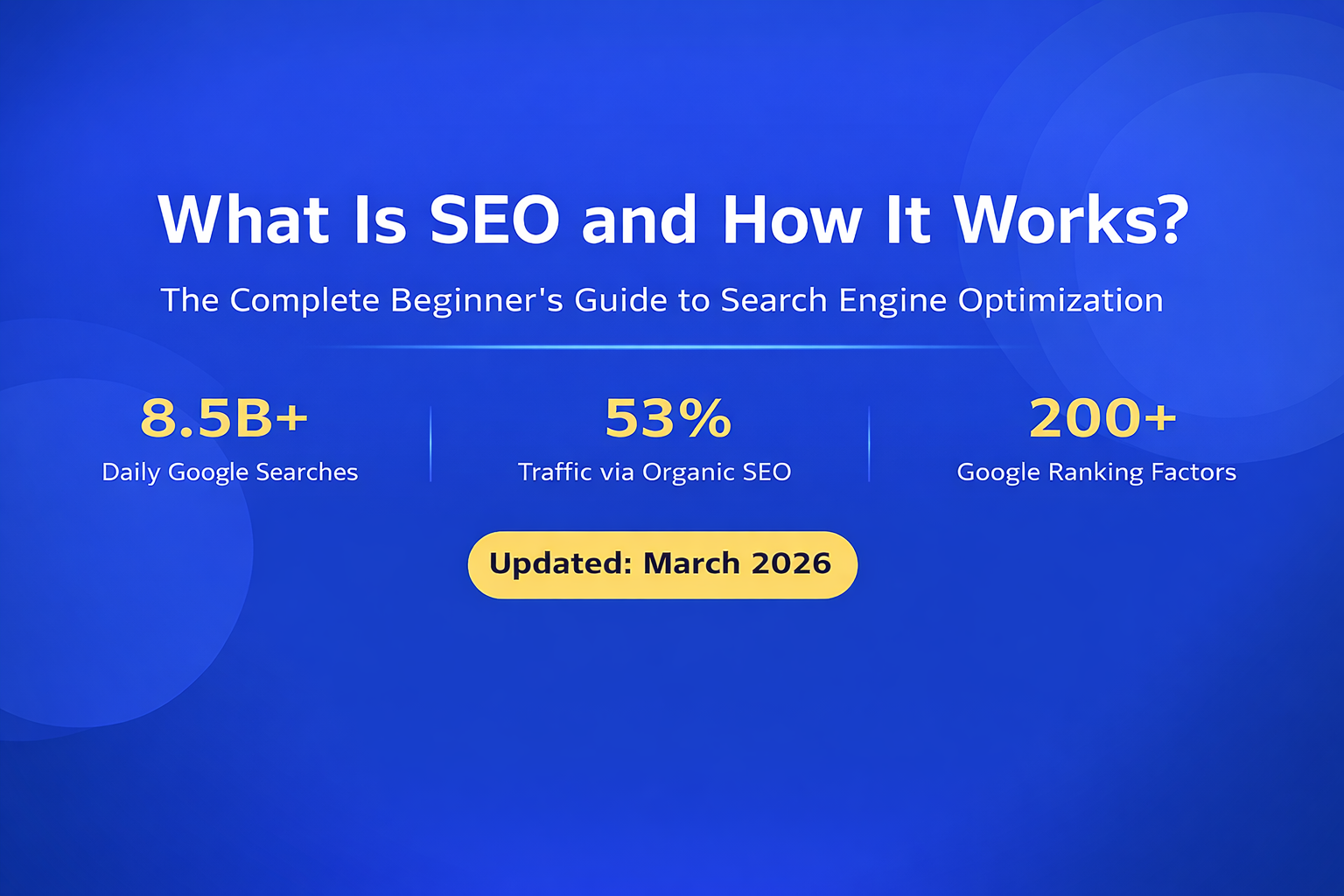
That is where SEO comes in. SEO, or Search Engine Optimization, is the art and science of making your website easy for search engines — and people — to find. And in 2026, with over 8.5 billion Google searches happening every single day, understanding what is SEO and how it works is not optional anymore. It is essential.
Whether you are a blogger, a business owner, a marketer, or just someone curious about how Google decides what shows up first, this guide will walk you through everything — in plain English, with real examples, and zero jargon overload.
Table of Contents
| 1 | What Is SEO? (The Simple Answer) |
| 2 | How Search Engines Actually Work |
| 3 | The Three Pillars of SEO |
| 4 | On-Page SEO: Optimizing Your Content |
| 5 | Off-Page SEO: Building Authority |
| 6 | Technical SEO: The Engine Under the Hood |
| 7 | SEO in 2026: What’s Changed? |
| 8 | How Long Does SEO Take to Work? |
| 9 | FAQs About SEO |
| 10 | Conclusion |
1. What Is SEO? (The Simple Answer)
SEO stands for Search Engine Optimization. It is the process of improving your website so it ranks higher in search engine results pages — commonly called SERPs.
When someone types “best running shoes” into Google, thousands of websites are competing for that top spot. SEO is what gets you there — or keeps you buried on page 10.
| Quick Definition: SEO is a set of strategies and practices that help search engines understand your content and show it to the right people at the right time. |
The goal of SEO is not just to rank. It is to attract the right visitors — people who are genuinely looking for what you offer. That means more traffic, more leads, and ultimately more revenue.
What Is SEO Not?
- It is not paid advertising. SEO is organic — you do not pay Google to rank.
- It is not a one-time fix. SEO is an ongoing process that requires consistent effort.
- It is not magic. There are no secret tricks that guarantee overnight results.
2. How Search Engines Actually Work
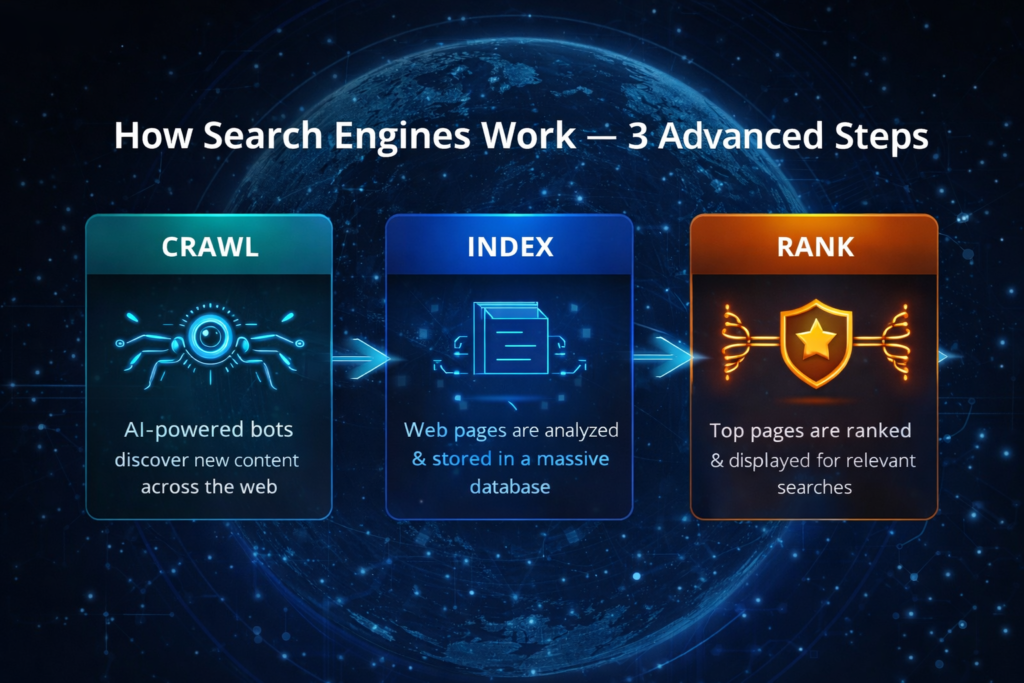
Before you can optimize for search engines, you need to understand what they actually do. Search engines like Google, Bing, and Yahoo work in three main stages:
Step 1: Crawling
Search engines use automated bots — often called “crawlers” or “spiders” — to browse the internet. These bots follow links from page to page, discovering new content along the way. Think of them as digital librarians who never stop reading.
Step 2: Indexing
Once a crawler reads your page, it stores the information in a massive database called the index. When your page is indexed, it becomes eligible to appear in search results. If Google has not indexed your page, it simply does not exist in search results.
Step 3: Ranking
This is where the real competition happens. When someone searches for a term, Google’s algorithm scans its index and ranks the most relevant, authoritative, and helpful pages for that query. Google uses over 200 ranking factors to make this decision — and those factors are constantly evolving.
| 2026 Insight: Google’s AI-powered Search Generative Experience (SGE) is now fully integrated into standard results. This means AI Overviews appear at the top of many search results, making it even more critical to rank within traditional organic results below those snippets. |
3. The Three Pillars of SEO
SEO can feel overwhelming because there are so many components. But at its core, everything falls into three main categories:
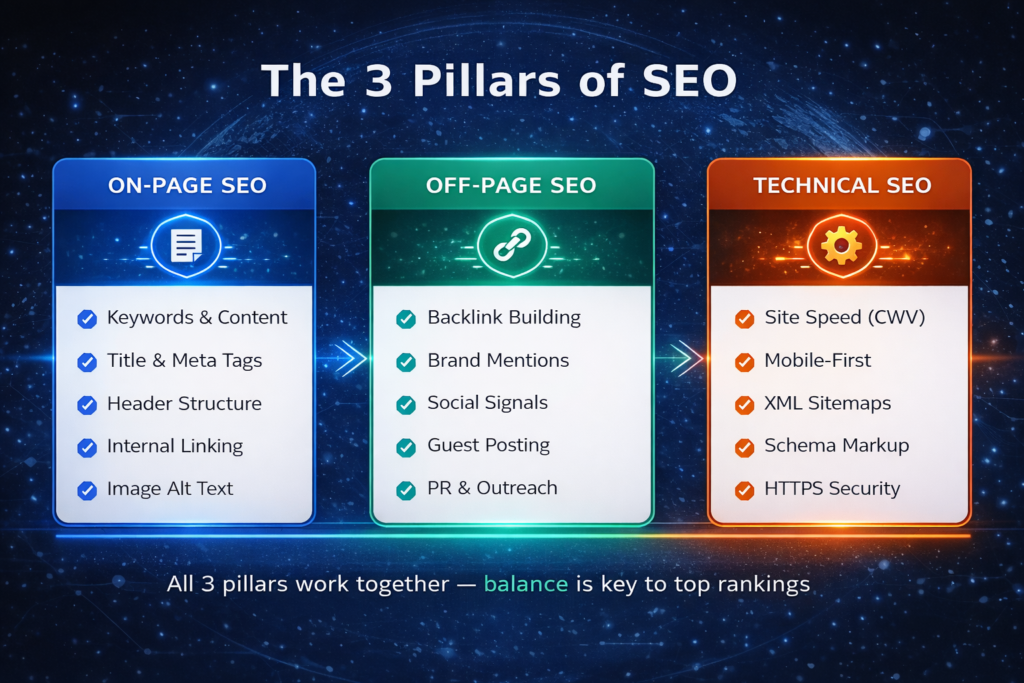
All three pillars work together. A website that excels in just one area will always be outranked by a site that balances all three.
4. On-Page SEO: Optimizing Your Content
On-page SEO covers everything you can control directly on your website. This is where most beginners start — and rightfully so.
Keyword Research: The Foundation
Keywords are the words and phrases people type into search engines. Before writing a single word, you need to know what your audience is actually searching for.
In 2026, keyword research goes beyond just finding popular terms. You need to understand search intent — the reason behind the search. There are four types:
- Informational: “What is SEO?” — the user wants to learn.
- Navigational: “Ahrefs login” — the user wants to find a specific site.
- Commercial: “Best SEO tools 2026” — the user is comparing options.
- Transactional: “Buy SEO audit service” — the user is ready to act.
Matching your content to the right intent is one of the most impactful SEO moves you can make.
Title Tags and Meta Descriptions
Your title tag is the blue clickable headline in search results. It should include your primary keyword and be under 60 characters. Think of it as your headline in a newspaper — it needs to grab attention fast.
The meta description (under 160 characters) is the short summary beneath your title. While it does not directly affect rankings, a compelling meta description significantly increases click-through rates.
Header Tags (H1, H2, H3)
Headers give structure to your content and signal to Google what each section is about. Use one H1 (your main title) and multiple H2s and H3s to break up the content logically.
Content Quality and EEAT
Since Google’s Helpful Content Update, content quality has become the single biggest ranking factor. Google now evaluates content based on EEAT:
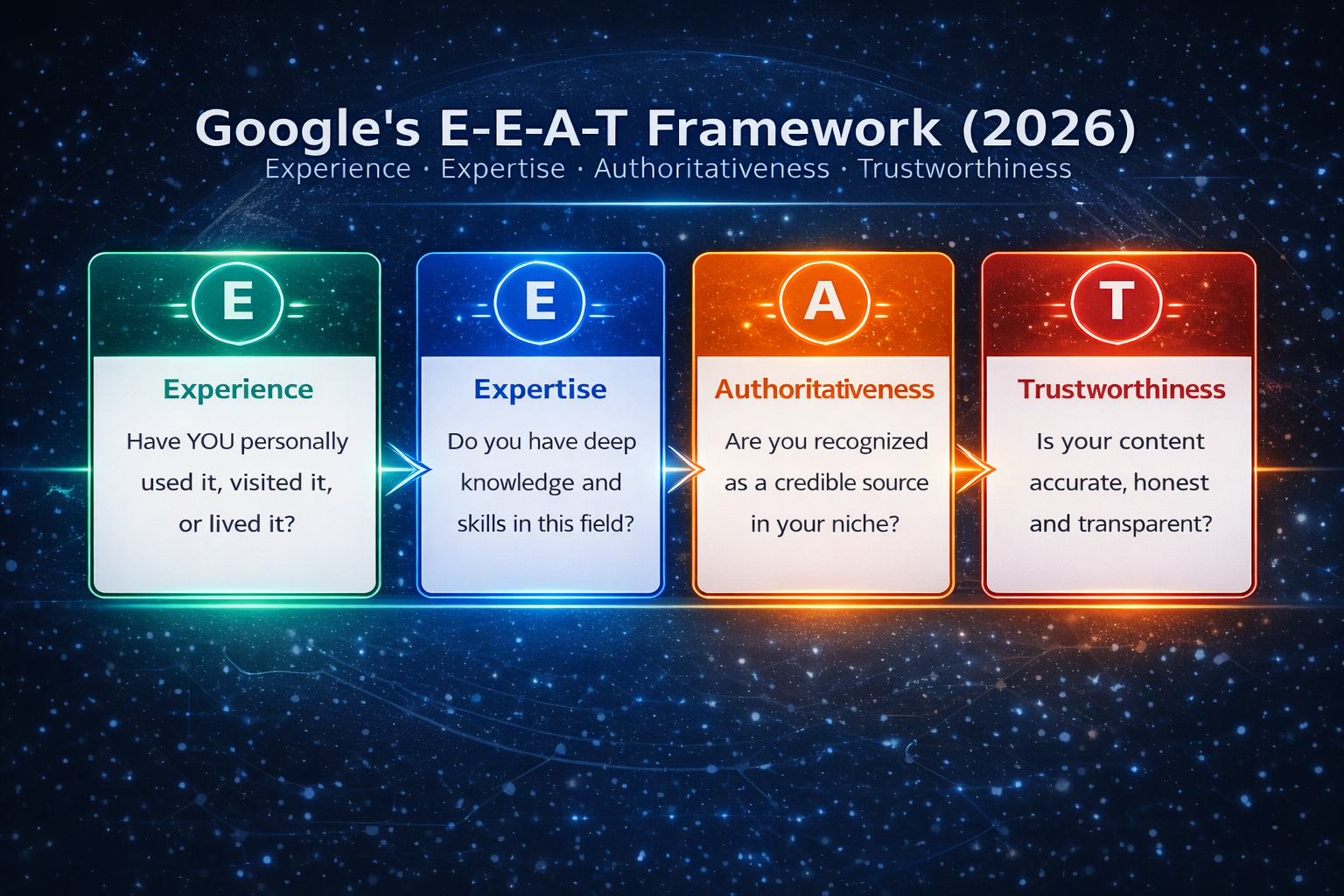
- Experience: Has the author actually used the product or visited the place?
- Expertise: Does the author have demonstrable knowledge in the field?
- Authoritativeness: Is the website recognized as a credible source?
- Trustworthiness: Is the content accurate, honest, and safe?
| Pro Tip: Add author bios to your articles with real credentials. Link to original research, cite reputable sources, and update older content regularly. These actions directly boost your EEAT signals. |
Internal Linking
Linking to other relevant pages on your own site helps visitors navigate and helps Google understand your site’s structure. Aim for 2 to 5 internal links per article, using descriptive anchor text.
Image Optimization
Images should have descriptive file names and alt text that includes relevant keywords. This improves accessibility and helps images rank in Google Image Search.
5. Off-Page SEO: Building Authority
If on-page SEO is about what you say about yourself, off-page SEO is about what others say about you. The most important off-page signal is backlinks.
What Are Backlinks?
A backlink is when another website links to yours. Think of each backlink as a vote of confidence. The more high-quality, relevant sites linking to you, the more trustworthy Google considers your content.
Not all backlinks are equal. One link from a respected industry publication is worth more than 100 links from low-quality directories.
How to Build Backlinks in 2026
- Write original research, statistics, or studies that others want to cite.
- Create tools, calculators, or templates that earn natural links.
- Guest post on relevant industry blogs.
- Use HARO (Help a Reporter Out) or similar platforms to get quoted in media articles.
- Build relationships with other content creators in your niche.
Brand Mentions and Social Signals
Unlinked mentions of your brand name across the web also contribute to your authority. While Google has not confirmed social media as a direct ranking factor, social signals like shares and engagement drive traffic, which indirectly boosts SEO.
6. Technical SEO: The Engine Under the Hood
You could have the most brilliant content in the world, but if your website is technically broken, Google will struggle to rank it. Technical SEO ensures the foundation of your site is solid.
Site Speed
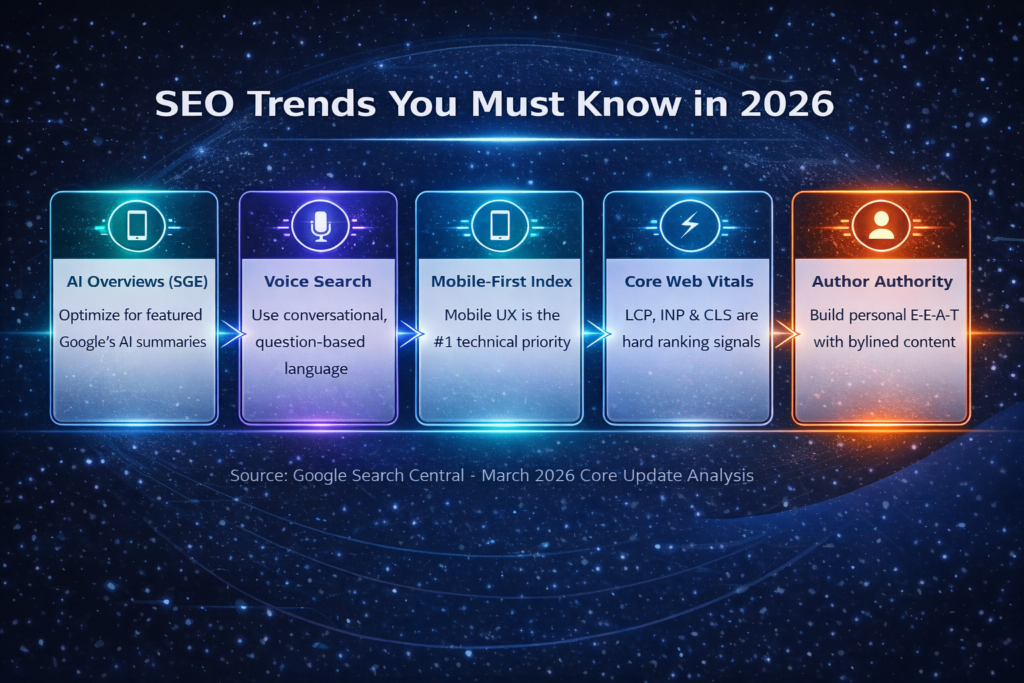
Google uses Core Web Vitals as a ranking factor. These include how fast your page loads (LCP), how quickly it responds to user interactions (INP — which replaced FID in 2024), and how stable the layout is (CLS).
A one-second delay in page load time can reduce conversions by 7%. Speed is not just an SEO issue — it is a user experience issue.
Mobile-First Indexing
Since 2021, Google primarily uses the mobile version of your site for indexing and ranking. In 2026, if your site is not mobile-friendly, you are fighting an uphill battle.
Crawlability and Indexability
- XML Sitemap: Helps Google discover all your pages.
- txt: Tells crawlers which pages to skip.
- Canonical Tags: Prevent duplicate content issues.
- Structured Data (Schema Markup): Helps Google understand your content for rich snippets.
HTTPS Security
Google confirmed HTTPS as a ranking signal back in 2014, and it remains relevant. If your site still runs on HTTP, getting an SSL certificate is a quick, impactful fix.
7. SEO in 2026: What Has Changed?
SEO is never static. The landscape in 2026 is dramatically different from even two years ago. Here is what matters most right now:
AI Overviews and SGE Optimization
Google’s AI-generated summaries now appear for hundreds of millions of queries. To get cited in these AI Overviews, your content needs to be clear, concise, and authoritative. Use structured FAQ sections, numbered steps, and definition-style answers.
Search Generative Experience (SGE) and Zero-Click Searches
More users are getting answers directly on the SERP without clicking. This means traditional traffic metrics are shifting. Focus on ranking for queries where users still need to visit a site for full value — comparisons, how-to guides, product pages.
Voice Search and Conversational Queries
With the rise of AI assistants and smart devices, voice searches now make up a significant portion of all queries. Optimizing for natural, question-based language is critical. Use conversational headings and clear answers within the first paragraph.
The March 2026 Google Core Update
Google’s March 2026 Core Update placed even heavier emphasis on firsthand experience and unique insights. Thin content — content that just summarizes what others have already said — lost significant rankings. Sites with original research, real case studies, and expert perspectives saw strong gains.
| 2026 Action Item: Audit your existing content for “experience gaps.” Add personal case studies, original data, or expert quotes to thin articles. This single action can dramatically recover rankings lost in recent updates. |
E-E-A-T and Author Authority
Google is placing greater weight on author-level authority. This means having bylined articles, maintaining consistent publishing cadence, and building your personal brand as a subject matter expert — especially in YMYL (Your Money, Your Life) niches like finance, health, and legal.
8. How Long Does SEO Take to Work?
This is the question everyone asks — and the honest answer is: it depends.
For a brand-new website in a competitive niche, expect 6 to 12 months before seeing meaningful organic traffic. For an established site targeting low-competition keywords, you might see movement in 8 to 12 weeks.
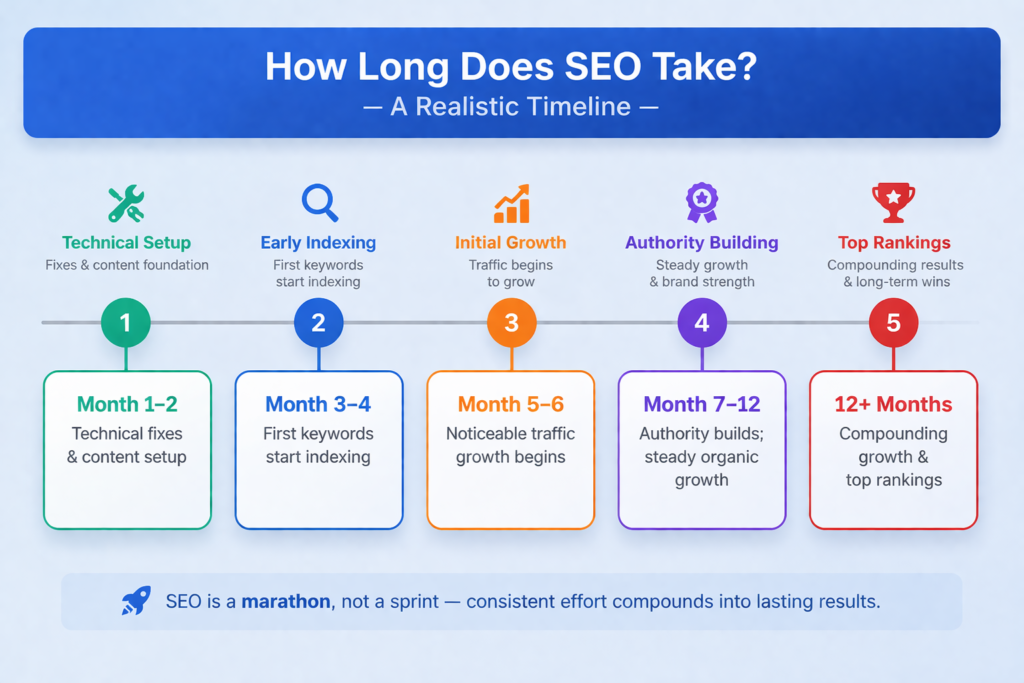
The most important thing to remember: SEO is a long-term investment. Businesses that treat it as a marathon — not a sprint — consistently outperform those chasing quick wins.
9. FAQs About SEO
| Q: What is SEO in simple words? |
| SEO (Search Engine Optimization) is the process of improving your website so that it appears higher in Google and other search engine results. When done right, more people find your site naturally — without you paying for ads. |
| Q: Is SEO still relevant in 2026? |
| Absolutely. Despite the rise of AI Overviews and changing SERPs, organic search still drives over 53% of all website traffic. SEO has evolved — it now requires more focus on experience, authority, and helpfulness — but its importance has not diminished. |
| Q: What is the difference between SEO and SEM? |
| SEO (Search Engine Optimization) focuses on earning unpaid organic rankings. SEM (Search Engine Marketing) is a broader term that includes both SEO and paid search advertising (like Google Ads). SEO takes longer but delivers sustainable results; paid ads stop the moment you stop paying. |
| Q: Can I do SEO myself, or do I need to hire someone? |
| You can absolutely start SEO yourself. Free tools like Google Search Console, Google Analytics, and Ubersuggest give you a strong starting point. As your site grows and competition increases, bringing in an experienced SEO consultant or agency often pays off significantly. |
| Q: What are LSI keywords and why do they matter? |
| LSI (Latent Semantic Indexing) keywords are terms related to your main keyword. For example, if your main keyword is “what is SEO,” related terms might include “search engine ranking,” “organic traffic,” or “Google algorithm.” Using these naturally helps Google understand the context of your content. |
| Q: How does Google decide what ranks on page one? |
| Google uses over 200 ranking factors, but the most important ones are: the quality and depth of your content, the number and quality of backlinks pointing to your page, your site’s technical performance (speed, mobile-friendliness), and how well your content matches the user’s search intent. |
| Q: What is local SEO and do I need it? |
| Local SEO is the process of optimizing your online presence to attract customers in your geographic area. If you run a physical business or serve a specific city or region, local SEO is essential. It includes optimizing your Google Business Profile, earning local citations, and getting location-specific reviews. |
10. Conclusion: Your SEO Journey Starts Now
Let us bring it back to that bakery analogy. SEO is essentially putting up the perfect sign, building the best location possible, getting featured in every food magazine, and making sure every customer who walks in becomes a loyal regular.
To summarize what we covered:
- SEO is the process of improving your visibility in search engine results organically.
- Search engines crawl, index, and rank content based on hundreds of signals.
- The three pillars — on-page, off-page, and technical SEO — all work together.
- In 2026, EEAT, AI-readiness, and firsthand experience are more critical than ever.
- SEO is a long-term game, but the compounding results are unmatched by any other marketing channel.
The best time to start with SEO was a year ago. The second best time is today.
Start small: pick one keyword, write one helpful article, fix one technical issue. Build from there. Every expert you admire once knew nothing about SEO — and they started exactly where you are right now.
| Ready to take action? Begin with a free Google Search Console account, verify your site, and check which queries are already bringing people to your pages. That data is your SEO roadmap. |
Need Help with YouTube SEO & Digital Growth?
If you want faster results and professional support, working with an experienced digital marketing agency can save time and effort.
Tap to Digital helps creators and businesses with:
- YouTube SEO and ranking strategies
- Keyword research and optimization
- Content growth planning
- Complete digital marketing solutions
Website: https://taptodigital.com/
Phone: +91 7206165897


